code grc

Exam Technique for Security Certifications

How to sit a security certification, as opposed to how to know the material: answer the capitalised qualifier, turn a mock into a diagnostic, work every distractor, budget the clock, and build the reflexes that fail under pressure. An independent course, not affiliated with or endorsed by ISACA, ISC2, CompTIA or Microsoft.

  • trending_upIntermediate
  • schedule5h 7m
  • menu_book9 堂課程
  • publicEnglish
  • workspace_premiumBasic
Exam Technique for Security Certifications

課程簡介

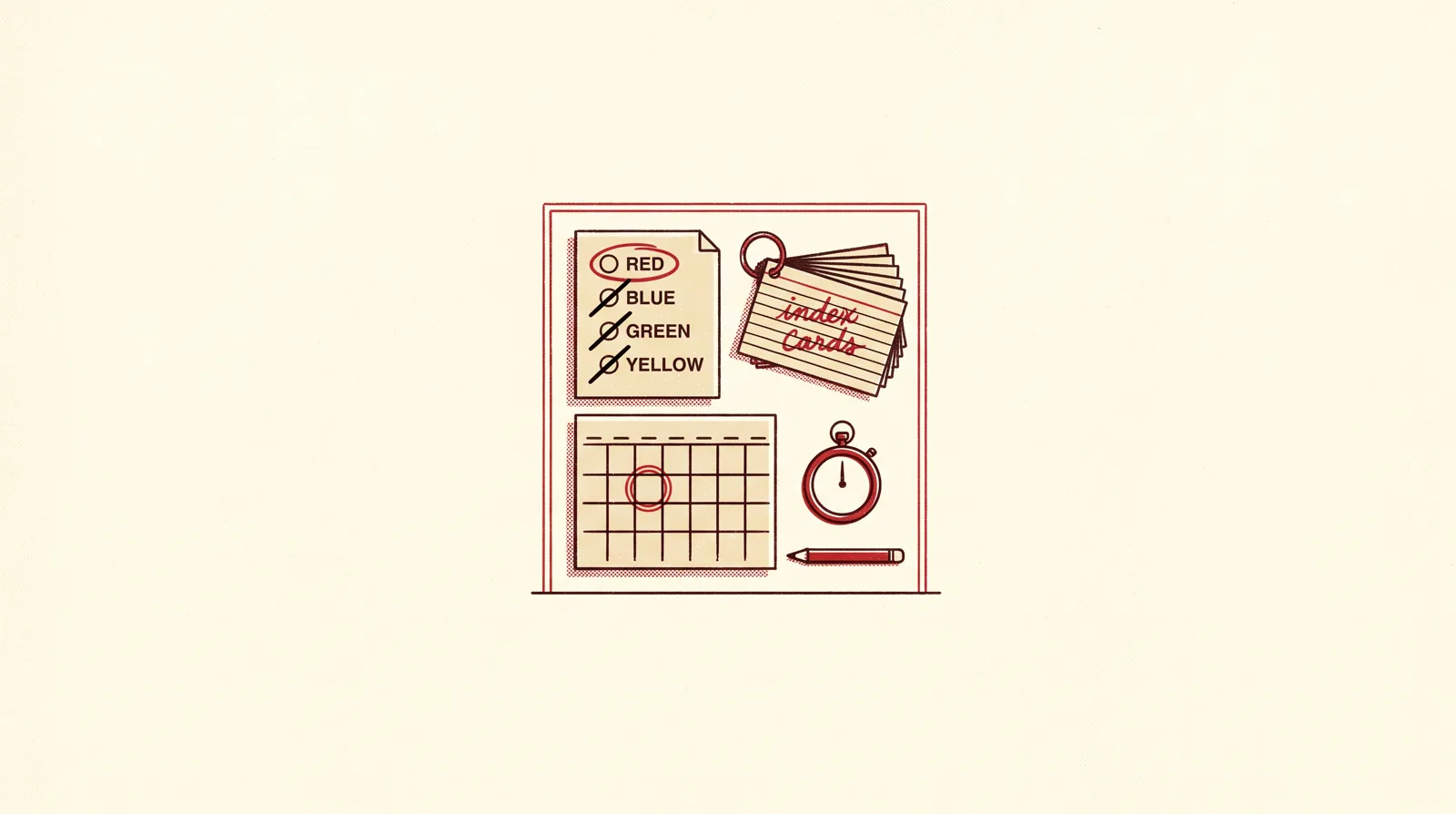
People who know the subject fail these exams. Not often because of a gap in the material — because of how they read a question, how they study a wrong answer, and how they spend four hours. Every stem in this format turns on one capitalised word. MOST. BEST. FIRST. GREATEST. PRIMARY. Four options are put in front of you and three of them are things a competent professional would genuinely do. Only one answers the qualifier. That single habit — read the qualifier first, the topic second — is the highest yield skill in the subject, and almost no course teaches it. Then the study machinery. A mock produces a number and a number is close to useless. Tag every question to a domain, count the misses per domain, and study the domain rather than the question. Work the justifications rather than the answer key: for every wrong option, why is it wrong? Most candidates read only the correct answer and take a quarter of what the question offered. Then the mechanics. What a scaled score is and why you cannot compute your mark from raw counts. Minutes per question, the two-pass method, when to flag and move on, and the arithmetic of guessing where there is no penalty. Building a reflex set for the handful of facts that must be instant rather than reasoned. What actually happens on exam day, including what to do when the first question is one you cannot answer. And what not to do: harvested question sites, which are a revocation offence at most bodies and are wrong as often as they are right; chasing a certificate for a job you already hold; and booking a date before you have run a diagnostic. Transferable across CISA, CRISC, CISSP, SC-200 and Security+. No tooling, no lab VM. Every exercise is a desk exercise: cut up a mock, sort it into piles, write four justifications, make cards, plan backwards from a date. This is an independent course. It is not affiliated with, endorsed by or approved by ISACA, ISC2, CompTIA or Microsoft, and it reproduces no material from any of them. Every question in it was written from scratch for this course. Exam formats, durations, question counts and scoring change — check your exam's current guide for every number.

課程大綱 · 3 個單元

lock隨存取權限解鎖
  1. 01 Answer the Qualifier
    3 堂課程·1h 27m

    Four options, all of them things a competent professional would do, and one capitalised word that decides which is the answer. If you take one thing from this whole segment, take this module. Read…

  2. 02 Turn the Mock Into a Diagnostic
    3 堂課程·1h 35m

    A mock produces a score. A diagnostic produces an instruction. Most people take mock after mock, watch the number move by a few points, and treat that as information. It is noise. This module is…

  3. 03 Reflexes, the Room and the Date
    3 堂課程·2h 5m

    Everything in this module is about performance rather than knowledge. The pairs you can define perfectly over coffee are the ones you swap at question one hundred and twenty, and the fix is drilling,…

常見問題

我將在 Exam Technique for Security Certifications 中學到什麼?
How to sit a security certification, as opposed to how to know the material: answer the capitalised qualifier, turn a mock into a diagnostic, work every distractor, budget the clock, and build the reflexes that fail under pressure. An independent course, not affiliated with or endorsed by ISACA, ISC
我需要事先具備經驗嗎?
建議在開始 Exam Technique for Security Certifications 前具備一些先備知識。
Exam Technique for Security Certifications 需要多長時間?
Exam Technique for Security Certifications 包含 3 個單元和 9 堂課程。你可以按自己的進度學習。
我如何取得存取權限?
Exam Technique for Security Certifications 包含在任何付費訂閱方案中。

程式設計 中的更多內容

First Program — Scratch for ages 5–9
Beginner First Program — Scratch for ages 5–9 Nine Scratch blocks, three sessions of about twenty-five minutes, and one small program a child of five to nine builds themselves. Written for the parent sitting beside them: what to click, what they will get stuck on, what to say when it goes wrong, and when to keep your hands off the mouse.
Binary, Hex and Data Units
Beginner Binary, Hex and Data Units The topic that costs more marks than any other on the paper, taught by hand. Bits and bytes, binary and hex in all six directions, the 1000-versus-1024 trap, file sizes, transmission times, overflow, two's complement and character sets. Every module ends in a timed drill marked the way an examiner marks it.
Python From a White Sheet
Beginner Python From a White Sheet The exact sequence nine students have already walked, from a blank file to a program that asks questions, checks the answers and refuses bad input. No prior programming. No maths. You will break it repeatedly, on purpose.
AI Without the Hype
Beginner AI Without the Hype What the model is actually doing when it answers you, why that produces something that looks like thinking, why it invents citations, and the cost mechanic almost nobody explains: a chat resends the entire conversation on every single turn. You will do the arithmetic yourself.
IGCSE and GCSE Computer Science — Theory That Actually Gets Marked
Intermediate IGCSE and GCSE Computer Science — Theory That Actually Gets Marked The theory half of the paper, taught so it survives the exam room. The memory hierarchy and what actually happens at boot. Compilers, interpreters and assemblers, including the answer that sounds right and scores nothing. Databases from a spreadsheet up to keys and normalisation. DNS and the full path between pressing Enter and seeing the page. Systems software, and the ethical and legal section that is the easiest ten marks on the paper.
Programming for the Exam — Python Answers That Score
Intermediate Programming for the Exam — Python Answers That Score The programming half of the paper, taught at exam pitch. Pseudocode translated both ways, because the mark scheme is written in a notation nobody practises. Trace tables done column by column, including the ones with a loop and a condition inside it. Linear and binary search, bubble and insertion sort, what each costs and the comparison questions boards love. Validation against verification, and the boundary test data everybody forgets. Procedures against functions, and a systematic method for finding your own error with four minutes left.